Pursuing a Ph.D. in Instructional Leadership with a concentration in Instructional Technology at The University of Alabama has been a transformative chapter in my academic and professional life. What began as a passion for improving mathematics instruction has evolved into a broader vision of leveraging immersive technologies and inclusive design to enhance learning outcomes for all students.
Below, I reflect on the key milestones, experiences, and inspirations that have shaped my journey, from my teaching roots in Nigeria to research in an immersive learning environment. Click each section below to explore the stages of my growth as a scholar, leader, and innovator.
Introduction: The Pursuit of Innovation
My academic journey began as a mathematics instructor in Nigeria, where I consistently sought innovative ways to improve student engagement and learning outcomes. While passionate about teaching, I quickly recognized the limitations of traditional instructional methods. This realization sparked a growing interest in the potential of technology to bridge learning gaps and enrich educational experiences. This curiosity and drive for impactful change ultimately led me to pursue a Ph.D. in Instructional Leadership with a concentration in Instructional Technology at The University of Alabama.
Academic Transformation Through IT Ph.D. Program
The IT Ph.D program has been a transformative experience, broadening my theoretical knowledge, deepening my technical skills, and reshaping my professional identity. Instructional Technology courses such as AIL 601: Principles of Instructional Technology expanded my understanding of learning theories and instructional design frameworks. Courses like AIL 604: Electronic Instructional Design, AIL 604: Distance Technologies, and AIL 605: Interactive Multimedia Processing provided hands-on experience in designing and implementing engaging digital learning environments. These courses also introduced me to emerging technologies—including virtual reality (VR), eye-tracking devices, and physiological sensors—that now form the core of my research and instructional design practice.
Research Integration and Professional Development
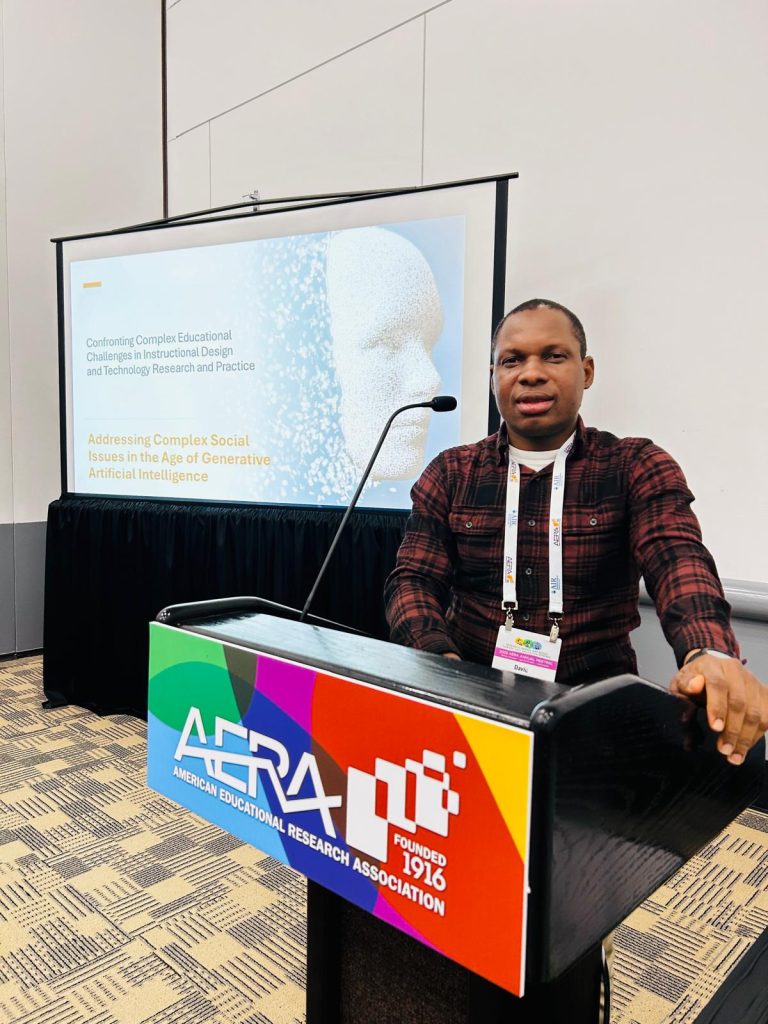
A defining feature of my doctoral experience has been the integration of research and professional development. As a Research Assistant and Lab Manager in the Adaptive Design of Immersive e-Learning (AdDIE) Lab, I have contributed to multiple projects exploring the use of immersive VR to support experiential learning among undergraduate engineering students. These experiences have sharpened my research design and data analysis skills, provided opportunities for conference presentations and scholarly publications, and deepened my commitment to evidence-based instructional technology solutions.
Leadership, Service, and Advocacy
The program has also cultivated my leadership and advocacy efforts. Through service as a senator in the Graduate Student Government Association and as a Graduate School Ambassador, I have participated in initiatives aimed at supporting graduate students and promoting educational innovation. My engagement in AIL 608: Diversity, Inclusion, Equity, and Access in Instructional Technology further solidified my commitment to creating inclusive, equitable, and accessible learning environments, particularly for underserved and marginalized communities.
Exploring Emerging Technologies for Impact
One of the most inspiring aspects of my doctoral journey has been my exposure to emerging technologies and their transformative potential. I am especially interested in the integration of generative AI, adaptive learning systems, and immersive environments to personalize learning experiences and foster deep, meaningful engagement. My research now focuses on how these technologies can support diverse learners, address equity gaps, and prepare students for the demands of a digital world.
Evolving Vision and Future Aspirations
Looking back, the Ph.D. program has profoundly influenced my teaching philosophy and career aspirations. What began as a goal to integrate technology into mathematics education has evolved into a broader vision of becoming a researcher, designer, and consultant in instructional technology—someone who bridges theory and practice to innovate educational systems both within academia and in professional sectors. The mentorship of faculty, collaborative research opportunities, and hands-on design experiences have all played vital roles in shaping this vision.
Conclusion
I am deeply grateful for the knowledge, support, and opportunities I have received throughout this program. As I continue advancing in my doctoral journey and beyond, I remain committed to leveraging my expertise to champion inclusive, technology-driven learning innovations that empower both educators and learners worldwide.